If you are searching for KMTC diploma courses, you are likely a KCSE graduate, a parent, or a working professional trying to figure out which health-related diploma to pursue at the Kenya Medical Training College (KMTC) — and what it will take to get in, pay for it, and build a career from it.
KMTC is Kenya’s largest and oldest health training institution, and its diplomas are among the most sought-after middle-level qualifications in the country because they lead directly into regulated, in-demand health careers such as nursing, clinical medicine, pharmacy, and medical laboratory science.

This guide walks you through every KMTC diploma programme, KMTC admission requirements, KMTC diploma requirements by course, fees, financing options, and realistic career outcomes — using only verified information from KMTC, KUCCPS, and HELB.
This article is for KCSE graduates choosing a course, parents planning finances, certificate holders looking to upgrade, and working professionals considering a career change into healthcare.

What Is a KMTC Diploma?
A KMTC diploma is a three-year (or three-and-a-half-year, for some nursing programmes) middle-level health training qualification offered by the Kenya Medical Training College, a state corporation under the Ministry of Health. To join a diploma programme, you generally need a KCSE mean grade of C (plain) or its equivalent, plus specific subject requirements (called “cluster subjects”) that vary by course. Diploma graduates register with the relevant professional regulatory body — for example, the Nursing Council of Kenya for nurses or the Clinical Officers Council for clinical officers — before they can practise.
About KMTC: A Quick Overview
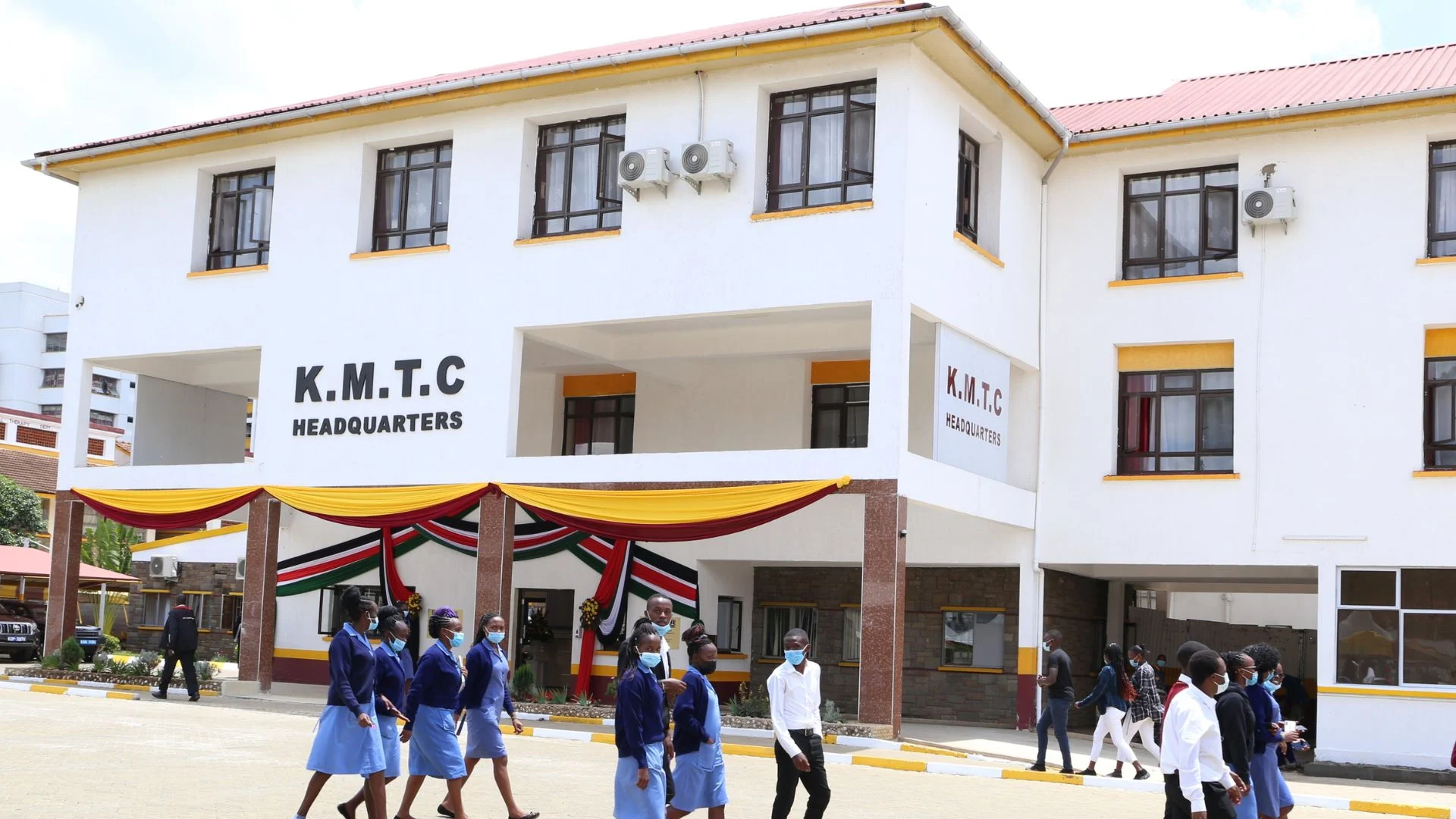
The Kenya Medical Training College is a semi-autonomous government institution established to train Kenya’s health workforce. According to KMTC’s official website, the college operates 7 faculties with 18 departments, offering 126 medical courses at Certificate, Diploma, Upgrading, Higher Diploma, and short-course levels, delivered across dozens of campuses countrywide. Its headquarters are located off Ngong Road, Nairobi.
For the March 2026 intake alone, KUCCPS advertised 21,774 slots across 36 certificate and diploma programmes offered in 98 KMTC campuses nationwide — an indication of just how widely KMTC training is distributed across the country, from Nairobi and Mombasa to smaller towns like Kabarnet, Kapenguria, and Taveta.
Full List of KMTC Diploma Courses
Based on KMTC’s official academic programmes listing, the diploma-level courses currently offered include:
| # | Diploma Course |
|---|---|
| 1 | Diploma in Clinical Medicine and Surgery |
| 2 | Diploma in Kenya Registered Nursing and Midwifery |
| 3 | Diploma in Kenya Registered Community Health Nursing |
| 4 | Diploma in Registered Nursing (Mental Health & Psychiatry) |
| 5 | Diploma in Medical Laboratory Sciences |
| 6 | Diploma in Pharmacy |
| 7 | Diploma in Public Health |
| 8 | Diploma in Health Records and Information Technology |
| 9 | Diploma in Health Promotion |
| 10 | Diploma in Health Counselling |
| 11 | Diploma in Health Insurance Management |
| 12 | Diploma in Nutrition and Dietetics |
| 13 | Diploma in Medical Social Work |
| 14 | Diploma in Radiography and Imaging |
| 15 | Diploma in Medical Engineering |
| 16 | Diploma in Physiotherapy |
| 17 | Diploma in Occupational Therapy |
| 18 | Diploma in Optometry |
| 19 | Diploma in Orthopaedic Technology |
| 20 | Diploma in Orthopaedic and Trauma Medicine |
| 21 | Diploma in Orthopaedic & Trauma Medicine (Paediatrics) |
| 22 | Diploma in Dental Technology |
| 23 | Diploma in Community Oral Health |
| 24 | Diploma in Mortuary Science |
| 25 | Diploma in Emergency Medical Technician |
Note: Not every diploma is offered every intake, and not every campus offers every course. Some programmes (such as Speech and Language Therapy) appear in some KUCCPS adverts and college communications but are periodically reviewed. Always confirm the current list and campus availability on the official KMTC admissions portal or the KUCCPS student portal before applying, since intakes change from one advertisement to the next.
Why Choose a KMTC Diploma?
- Direct link to regulated professions. Most KMTC diplomas lead to registration with a specific professional council (e.g., Nursing Council of Kenya, Clinical Officers Council, Kenya Medical Laboratory Technicians and Technologists Board), which protects the value of the qualification in the job market.
- Nationwide accessibility. With training happening in dozens of campuses across almost every county, students can often train close to home.
- Strong public-sector demand. Kenya’s public health system, run by the Ministry of Health and the 47 county governments, continues to recruit clinical, nursing, laboratory, and allied health cadres.
- Pathway to further study. KMTC diploma holders can progress to Higher Diploma or degree programmes at KMTC-affiliated or partner universities.
- Recognized qualification levels. The Kenya National Qualifications Authority (KNQA) has evaluated and accredited KMTC as a Qualification Awarding Institution, and in some cases (such as select Higher Diploma programmes) has designated the qualification as equivalent to a university degree on the National Qualifications Framework — a strong signal of the credibility of KMTC training.
KMTC Admission Requirements for Diploma Courses
KMTC’s official entry-requirements table sets out the general minimums per training level:
| Level | Minimum Entry Requirement | Duration |
|---|---|---|
| Certificate | KCSE mean grade C- with relevant subject combination | 2 years (2½ years for nursing) |
| Diploma | KCSE mean grade C with relevant subject combination (e.g., English, Kiswahili, Biology/Biological Sciences, Mathematics, Chemistry, Physics/Physical Sciences) | 3 years (3½ years for Community Health Nursing) |
| Upgrading | Certificate holder in a relevant field, plus (typically) two years’ work experience | 2 years (18 months for Community Health Nursing) |
| Higher Diploma | Diploma holder in a relevant field, plus at least two years’ work experience | 1 year |
Minimum KCSE Grades Required (Cluster Subjects)
The mean grade C requirement is only the starting point. Every diploma course has its own specific “cluster subjects” — the individual subject grades KUCCPS and KMTC use to determine eligibility. For example, KUCCPS advertisements typically specify requirements such as:
- A pass in English or Kiswahili (often grade C)
- A pass in Biology or Biological Sciences (commonly D+ or higher)
- A pass in Chemistry, Mathematics, or Physics/Physical Science (varies by course)
These requirements differ meaningfully between courses. A Diploma in Health Insurance Management, for instance, has a different subject combination from a Diploma in Radiography and Imaging or a Diploma in Clinical Medicine and Surgery. Because the exact cluster subjects and grades change slightly with each intake advertisement, you should always cross-check your specific KCSE results against the current KUCCPS/KMTC course advert rather than relying on a generic mean grade.
Tip: Use the official KUCCPS course search on the KUCCPS student portal, or the downloadable KMTC intake advert, to confirm you meet the exact subject and grade requirements for your chosen diploma before applying.
How to Apply for a KMTC Diploma
There are two main application routes depending on your situation:
- KCSE school leavers (Form Four leavers) and holders of grades C and D applying for government-sponsored slots generally apply through KUCCPS during the advertised intake windows (KUCCPS periodically opens applications for KMTC certificate and diploma programmes, including special “immediate intake” windows for candidates who missed earlier university/college placement).
- Self-sponsored, upgrading, and Higher Diploma applicants typically apply directly through the KMTC Admissions Portal (admissions.kmtc.ac.ke).
Step-by-Step Application Process
- Read the current intake advertisement or the KMTC Academic Programmes Booklet carefully to confirm the courses, campuses, and requirements on offer.
- Confirm you meet the specific cluster-subject and grade requirements for your chosen diploma.
- Apply online — either via the KUCCPS student portal (for KUCCPS-advertised slots) or the KMTC admissions portal (for direct/self-sponsored applications).
- Pay the required non-refundable application fee via mobile money as prompted (KMTC’s own portal has previously charged an application fee of about KES 2,072; KUCCPS applications follow KUCCPS’s own fee structure).
- Submit your application before the deadline — KMTC intakes close once slots are filled, so early application improves your chances.
- Regularly check the email address used during application for admission notifications and further instructions.
- Once admitted, report to your allocated campus with the required original academic documents for verification.
Caution: KMTC and KUCCPS routinely warn applicants about scammers demanding payment for “guaranteed” admission. Apply only through the official portals listed above.
Course Duration
Most KMTC diploma programmes run for three years, split into theory and clinical/practical placement. Exceptions include:
- Diploma in Community Health Nursing – 3½ years
- Some upgrading pathways (certificate-to-diploma) – around 2 years, depending on the department
Programmes combine classroom instruction, laboratory/skills-lab practice, and supervised clinical attachment in hospitals and health facilities, which is a core part of KMTC training and a requirement for professional registration in most cadres.
What You Will Study
While the specific units differ by specialization, most KMTC diploma curricula share a common foundation before branching into specialized modules. Typical building-block units include:
- Anatomy and Physiology
- Medical Microbiology and Parasitology
- Pharmacology
- Community Health and Primary Health Care
- Communication Skills and Medical Ethics
- Research Methods and Biostatistics
- ICT/computer applications
On top of this foundation, each course adds specialty units — for example, Clinical Medicine students study clinical diagnosis and management of disease; Medical Laboratory Sciences students study haematology, clinical chemistry, and histopathology; Pharmacy students study pharmaceutics and dispensing practice; Nutrition and Dietetics students study human nutrition and diet therapy.
Skills You Will Gain
- Clinical assessment, diagnosis, or technical procedures relevant to your specialty
- Patient communication, counselling, and health education skills
- Infection prevention and control practices
- Record-keeping and use of health information systems
- Teamwork within multidisciplinary health facility settings
- Professional and ethical conduct in healthcare delivery
Career Opportunities After a KMTC Diploma
KMTC diploma holders are trained for specific, regulated health careers. Depending on your specialization, you can work as a:
- Registered/Enrolled Nurse (registered by the Nursing Council of Kenya)
- Clinical Officer (registered by the Clinical Officers Council)
- Medical Laboratory Technologist (registered by the Kenya Medical Laboratory Technicians and Technologists Board)
- Pharmaceutical Technologist (registered by the Pharmacy and Poisons Board)
- Public Health Officer/Technician
- Radiographer (registered by the Radiation Protection Board)
- Physiotherapist or Occupational Therapist
- Nutritionist/Dietitian
- Health Records and Information Officer
- Medical Engineering Technician
- Community Oral Health Officer or Dental Technologist
Professional Registration
Most clinical cadres cannot practise legally in Kenya without registering (and periodically renewing a practising licence) with the relevant professional council listed above. Registration usually requires proof of the diploma, completion of internship/attachment hours, and, for some cadres, passing a licensing examination. Check with your specific regulatory body for the exact requirements before graduating.
Industries and Employers
- Public sector: Ministry of Health, county government health departments, and public hospitals (e.g., referral and county hospitals) remain the largest employers of KMTC graduates.
- Faith-based and NGO health facilities: Organizations under umbrella bodies such as the Christian Health Association of Kenya (CHAK) and various NGOs run hospitals and clinics that recruit diploma holders.
- Private hospitals and clinics: Private healthcare is a growing employer, especially in urban centres.
- International opportunities: Some cadres (particularly nursing) pursue opportunities abroad, though this typically requires additional licensing exams (e.g., NCLEX for nursing in the US) and verification of your KMTC qualification.
Self-Employment Opportunities
Certain KMTC-trained professionals can run their own practices once licensed, subject to the rules of their regulatory body — for example, licensed pharmaceutical technologists can operate registered pharmacies/chemists, and registered clinical officers or nurses may run licensed clinics in some circumstances. Community health promotion, private laboratory services, and nutrition consultancy are other realistic self-employment paths for qualified graduates.
On Salaries
Public-sector salaries for KMTC-trained cadres follow the government’s official job-group and scheme-of-service structures set by the Salaries and Remuneration Commission (SRC), and these change periodically through collective bargaining agreements and reviews. Private-sector pay varies widely by employer, location, and experience. Rather than rely on unverified salary figures circulating online, check the latest SRC circulars or speak with your professional council for accurate, current pay-scale information for your specific cadre.
KMTC Campuses Offering Diploma Courses
KMTC trains students across a large and growing network of campuses spread throughout Kenya — from major cities like Nairobi, Mombasa, Kisumu, Nakuru, and Eldoret to county-level campuses such as Kabarnet, Kapenguria, Makindu, Garissa, Kwale, and many more. Not every campus offers every diploma; course availability by campus is listed in each intake’s official advertisement. Always check the current advert or the KMTC admissions portal to confirm where your chosen diploma is offered in a given intake.
KMTC Diploma Fees
KMTC fees are structured into regular (Kenyan resident) and foreign (international student) categories, and the exact amount depends on the specific course, campus, and intake. KMTC states clearly that its fee structure is subject to periodic revision, and it publishes an official fee structure that students should consult directly rather than relying on older or third-party figures. In addition to tuition, students should budget for:
- Application fees (paid at the point of application, e.g., via mobile money)
- Stationery and textbooks (student’s responsibility)
- Specialized equipment for certain courses (e.g., stethoscopes for clinical courses)
- Accommodation and upkeep, where applicable
Recommendation: Download the current fee structure from the official KMTC website or ask your allocated campus’s finance office directly, since fees are reviewed periodically and vary by course and campus.
HELB and Financial Aid for KMTC Students
For many years, KMTC students could not access loans from the Higher Education Loans Board (HELB) because KMTC falls under the Ministry of Health rather than the Ministry of Education, which HELB traditionally serves. This changed with the introduction of the KMTC Students Financing Scheme, a partnership between KMTC and HELB (through the Higher Education Financing/HEF portal) designed to help cover tuition fees for certificate and diploma students. In 2026, HELB opened the 2026/2027 KMTC loan application window (from late August to end of September 2026) for both first-time and continuing certificate and diploma students, following continued government commitments to extend loan access to KMTC learners.
Because this financing arrangement has evolved significantly in recent years (including funding interruptions and Treasury interventions), students should:
- Check the current status directly on the Higher Education Financing portal (hef.co.ke) or HELB’s official channels
- Watch for official KMTC and HELB announcements on application windows and deadlines
- Explore additional support such as bursaries from county governments, the National Government Constituency Development Fund (NG-CDF), and faith-based or NGO scholarships, since government financing may not cover the full cost of training
Internship and Clinical Attachment
Clinical/practical attachment is a compulsory, assessed component of nearly every KMTC diploma. Students are placed in hospitals and health facilities to gain hands-on experience under supervision, and this attachment period is often a prerequisite for professional registration after graduation. Students should budget separately for costs associated with attachment (transport, accommodation near attachment sites, and sometimes facility fees), as KMTC notes these are the student’s responsibility.
Read also: Diploma in Community Health in Kenya
Advantages of a KMTC Diploma
- Leads to a specific, regulated profession with clear registration requirements
- Widely respected qualification recognized by employers across Kenya’s public and private health sectors
- Available in many locations countrywide
- Clear progression pathway to Higher Diploma or degree studies
- Strong practical/clinical component that builds real workplace competence
Disadvantages and Challenges to Consider
- Historically limited access to HELB financing compared to university students, though this is now improving
- Competitive admission for popular courses (e.g., Clinical Medicine, Nursing) due to high applicant numbers
- Clinical/practical components require full-time, consistent attendance, which can be difficult for working applicants
- Some specializations have fewer job openings than others, so it pays to research demand for your specific cadre
- Professional registration and licensing add extra steps (and sometimes fees) after graduation before you can practise
Who Should Take a KMTC Diploma?
A KMTC diploma is a strong fit if you:
- Have (or can attain) at least a C plain in KCSE with the right cluster subjects
- Want a direct, practical pathway into a specific healthcare profession
- Are comfortable with a curriculum that combines classroom learning with hands-on clinical attachment
- Are looking for a nationally recognized, regulated qualification rather than a general academic diploma
- Want an affordable, relatively quick route (3 years) into stable, in-demand employment
It may be less suitable if you are certain you want a university degree from the outset and can meet direct university entry requirements, though even then, a KMTC diploma can serve as a stepping stone into a related degree programme later.
Common Mistakes Students Make
- Applying for a course without checking the exact cluster-subject requirements, then getting disqualified despite meeting the general mean grade.
- Missing application deadlines because KUCCPS/KMTC intakes close once slots fill up.
- Assuming all campuses offer all courses — always confirm campus-course availability before applying.
- Not budgeting for attachment and equipment costs, which are separate from tuition.
- Ignoring professional registration requirements and assuming the diploma alone is enough to practise.
- Falling for scammers who promise “guaranteed admission” for a fee outside official portals.
Tips for Succeeding in Your KMTC Diploma
- Confirm your cluster subjects early and apply as soon as intakes open.
- Keep a close eye on your official application email for updates.
- Start budgeting early for fees, attachment costs, and personal upkeep; apply for HELB, bursaries, or scholarships as soon as windows open.
- Take clinical attachment seriously — it builds the practical competence employers and regulators expect.
- Join or connect with your relevant student/professional association early to understand licensing requirements before you graduate.
- Consider your long-term goals: if you eventually want a degree, ask about university upgrading pathways for your specific diploma before you finish.
Frequently Asked Questions (FAQs)
1. What is the minimum grade required for a KMTC diploma? Generally, you need a KCSE mean grade of C (plain), plus specific subject requirements that vary by course. Always check the exact cluster subjects for your chosen diploma in the current intake advertisement.
2. How long does a KMTC diploma take? Most diploma courses take three years. The Diploma in Community Health Nursing takes three-and-a-half years due to its extended practicum requirements.
3. How do I apply for a KMTC diploma course? KCSE school leavers typically apply through the KUCCPS student portal during advertised intakes, while self-sponsored, upgrading, or Higher Diploma applicants apply through the KMTC admissions portal (admissions.kmtc.ac.ke).
4. Can I get a HELB loan for a KMTC diploma? Yes, as of recent intakes. KMTC partnered with HELB to launch the KMTC Students Financing Scheme, and HELB opened the 2026/2027 loan application window for KMTC certificate and diploma students. Check the Higher Education Financing portal for current eligibility and deadlines.
5. What is the difference between a KMTC certificate and a diploma? A certificate requires a minimum KCSE mean grade of C- and usually takes two years (2½ for nursing), while a diploma requires a higher minimum grade of C and typically takes three years, with more advanced clinical content and broader career scope.
6. Which is the most popular KMTC diploma course? Clinical Medicine and Surgery, Nursing, and Medical Laboratory Sciences are consistently among the most applied-for and competitive KMTC diploma programmes due to strong job market demand.
7. Can I upgrade my KMTC diploma to a degree? Yes. Many public and private universities in Kenya offer upgrading/bridging pathways for KMTC diploma holders into related bachelor’s degree programmes, subject to each university’s specific entry requirements.
8. Do all KMTC campuses offer all diploma courses? No. Course availability differs by campus and by intake. Always check the specific course-and-campus list in the current intake advertisement before applying.
9. Is a KMTC diploma recognized outside Kenya? KMTC is a recognized Qualification Awarding Institution under the Kenya National Qualifications Authority (KNQA), and some of its qualifications have been benchmarked against the National Qualifications Framework. For work abroad, most countries still require additional licensing exams or credential verification specific to that country’s health regulator.
10. What professional body do I register with after graduating? It depends on your specialization — for example, nurses register with the Nursing Council of Kenya, clinical officers with the Clinical Officers Council, and laboratory technologists with the Kenya Medical Laboratory Technicians and Technologists Board.
11. How much are KMTC diploma fees? Fees vary by course, campus, and whether you are a Kenyan resident or international student, and they are revised periodically. Always check the official current fee structure published by KMTC or confirm with your allocated campus.
12. Is KMTC a TVET institution? No. KMTC is a specialized state corporation under the Ministry of Health, distinct from the TVET institutions regulated primarily under the Ministry of Education and TVETA, although it shares the goal of producing skilled middle-level professionals for the Kenyan economy.
13. What happens during clinical attachment? You are placed in a hospital or health facility for supervised, hands-on practice relevant to your course. This is a compulsory, assessed part of training and is often required before you can register with your professional council.
14. Can working professionals apply for a KMTC diploma? Yes, especially through upgrading pathways for certificate holders. However, note that clinical/practical components require consistent, often full-time attendance, which can be demanding to combine with a full-time job.
15. What should I do if I don’t qualify for my first-choice diploma? Consider related certificate courses as a stepping stone (with a plan to upgrade later), or explore diploma courses with cluster-subject requirements that better match your KCSE grades. KMTC’s wide course range means there is often a related pathway even if your first choice isn’t accessible immediately.
Final Verdict: Is a KMTC Diploma Right for You?
A KMTC diploma remains one of the most reliable, practical routes into a stable healthcare career in Kenya — provided you meet the specific cluster-subject requirements for your chosen course and are prepared for the hands-on demands of clinical training. It suits KCSE graduates who want a focused, three-year pathway into a regulated profession, as well as certificate holders looking to upgrade their qualifications and career prospects.
Before you apply, take these practical next steps:
- Confirm your KCSE grades against the current cluster-subject requirements for your chosen diploma.
- Check the latest intake advertisement on the KUCCPS or KMTC portal for available courses, campuses, and deadlines.
- Plan your finances early — check HELB/HEF eligibility, county bursaries, and KMTC’s official fee structure.
- Apply only through official KUCCPS or KMTC channels to avoid scams.
With the right preparation, a KMTC diploma can be the foundation for a long, meaningful career in Kenya’s health sector.
Read also: